
Christina Tholander is a Danish elephant researcher at the African Elephant Research Unit (AERU) at Knysna Elephant Park, South Africa. Though her primary focus is in the lab, she also has a role as a volunteer coordinator. She studied biochemistry at university and has always loved elephants. We asked her a few questions about her role at AERU, the volunteer program, and her favorite animal.
Why did you become an elephant researcher?
It wasn’t planned, it was a matter of following your dreams, and when the opportunity presented itself, I didn’t hesitate at all. I joined the research unit of Knysna Elephant Park as a volunteer in 2016, and towards the end of my stay, I was offered a position, so I accepted it and never looked back. Initially, I planned to stay for 3 years, but I’m now in my 6th year, and I’m not going anywhere!
What kind of research does AERU do?
Our main focus is doing research on the welfare of elephants in a captive environment. It’s important to note that this is not in a zoo-like environment, though. Knysna Elephant Park is a huge, fenced area that is more like a reserve. It’s also a tourist destination, so most of the research we do is from this aspect. One of my personal main tasks at the lab is collecting dung samples for physiological analysis (laughs).
Why is it important to do research on captive elephants?
We live in a world where animal habitats become less and less. It’s estimated that by 2100, the population in Africa alone will have doubled – but where are these people going to live? Obviously, the land will be taken from wildlife reserves, and there will be less and less of them. It’s quite controversial, but in my opinion, we have created this problem, and we need to take responsibility and find a solution. That’s why there is a need for an establishment like the Knysna Elephant Park.
There has been a lot of research on classical zoos and wild herds in nature, but not in a facility like the one we have here. It teaches us a lot about the elephants’ welfare, and the more research we do, the more we learn about the language these animals speak. We then report our findings to the park’s management and suggest changes for the benefit of the elephants.
Have there been changes in the park thanks to your research?
Yes! For example, years ago elephant riding was part of the tourist experience at Knysna Elephant Park. We told the park this should not be done, so they stopped offering it.
Another example is that the park had built a big stable for the elephants, and they first thought each elephant would want its own pen. After researching this, we suggested that the elephants would benefit more from one big stable, without individual pens. The park listened to us and changed this as well.
Can you tell us more about the volunteer program at AERU?
As a volunteer, we get you involved in everything! No day is the same, and there are always unpredictable things happening around here. We offer two programs; the Walking With Giants Program, which requires volunteers to stay for at least 3 weeks, and the 1-week Everything Elephant Program, for volunteers that can’t stay for a longer time.
The first week of the Walking With Giants Program is an introduction and training. You need to learn how to identify the elephants, for example. During the second week, you get familiarized with the program and starting from the third week, you will really start to enjoy it.
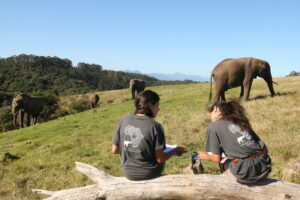
We have two studies that we do every day, where the volunteers get to partake in: herd activity (what are the elephants doing?) and the nearest neighbor (who’s friends with whom?). But volunteers also get to help with other, temporary, studies. We’re currently doing a study on audio enrichment; we play different types of music for the elephants, and try to see which one is their favorite. Right now, they really seem to enjoy classical music. (laughs)
There’s a discussion going on about whether volunteering is good or not. What’s your opinion on this matter?
I think it has to do with finding the right place. Unfortunately, there are a lot of projects out there that have become money-making machines. As a volunteer traveler, you have to be careful not to end up with one of these. The best advice I can give is to search for a particular place on social media and to look for people who have volunteered here. Ask them about their experience!
If you’ve never done it, I would highly recommend volunteer travel, just to see if it’s something you can benefit from. It gives back to you, but it also benefits the local community of the place you visit.
We often hear stories about elephants being poached for ivory, how are you dealing with that?
Luckily, elephant poaching isn’t a problem in South Africa, but it is in Zimbabwe and Namibia. Rhino poaching, on the other hand, is a problem here. Just a few weeks ago, we lost 18 rhinos in one week. The pandemic hasn’t helped either because people starve, and they would do anything for money.
Can you tell us something about South Africa?
It’s not dangerous down here! (laughs) South Africa has the reputation of being a very violent place, but I don’t agree with this. It’s true that you have to be precautious and that there are certain places you better avoid, but it’s the same for any country. As long as you’re vigilant, South Africa is a safe country to visit.


0 Comments