

It’s a special life, to be a veterinarian and wildlife photographer while working all over the globe. But, being able to combine that with community based conservation definitely gives you some great experiences in life. Björn Donnars from the Netherlands has made this scenario his real life. One of the projects he visited displays a beautiful balance between wildlife photography and community based conservation.
A visit to the stars of meerkat manor
Meerkats. Who doesn’t know these cute but fierce creatures that stand straight up while looking for predators. You might know them from Animal Planet or perhaps you have seen the series Meerkat Manor. It’s hard to imagine that these animals can be seen in real life, yet today it is easier than ever. The reason why you can see these animals in the wild is dueto a phenomenon called habituation. It’s a process where animals get used to human presence without being disturbed. You might recognise it from the gorillas and chimpanzees of Central- and East-Africa. But, before we tell you the whole story of seeing these incredible animals let’s just explain something about the animals first.
Let’s get to know them
Meerkats (Suricata suricatta) are mammals and are part of the mongoose family. A family of small predators living in Africa, Asia and Southern Europe. Meerkats are lightgrey to yellowish brown of color and have poorly defined bands on their back. The animal is about 30 (24-32) centimeters tall from head to tail and females are usually bigger than males. They weigh less than 1 kilogram. Meerkats live in groups with a strong bond, which can grow up to 30 individuals. The group consists of multiple families and their young. Females are dominant over the males and only the more dominant couples within the group mate. All individuals help with raising the pups, especially the meerkats lower in rank. It’s a clearly defined structure.
The home range of a single group is usually about 5 km2 and includes multiple burrows which can be 50-100 meters long. Meerkats can and will be very vigilant when they come across another group of meerkats which can lead to heavy injuries and even death. Mostly pups die from clan fights.
Meerkats are omnivorous, but live primarily on an insectivore diet, eating mainly beetles and moths. They do also feed on small amphibians, lizards and are known to eat scorpions. However, when there is no “meat” around they can also live on seeds and roots. Meerkats are very vulnerable when foraging, so there are always some meerkats on the look-out. They look for higher grounds and make themselves tall by standing straight up. When danger is spotted, an alarm call will be used. It’s a well developed system, with different calls for different types of danger.
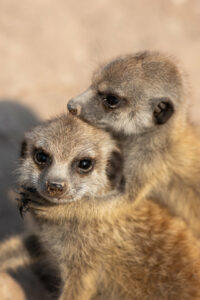
Meerkats in Botswana
Traveling around the world doesn’t mean I can see the Meerkats everywhere. They can only be found in the deserts and semi-deserts of Southern Africa and live within the borders of just five countries. They can be found in Angola, Botswana, Lesotho, Namibia and South-Africa. The population of meerkats is stable and the IUCN classifies meerkats as least concern. Nevertheless, finding meerkats in the wild during a game drive can be very tricky and difficult. Usually when you do find them on a game drive, they will flee as soon as possible. This makes it almost impossible to see and adore them. Luckily, there is an animal friendly alternative.
In Gweta, Botswana, you can go on an excursion to find meerkats. Here, they do not flee at the presence of people, because of habituation. Don’t confuse this with animals that have been fed or trained to be near people. What they did is the following: one person would be present within range of the meerkats. It starts with being far away, so the meerkats can get used to the smell of people. Step by step that one person comes closer to the meerkat family. It is a process that can take months or even years, but eventually it leads you to a situation like the one in Gweta, where humans can be in the presence of the meerkats, without them fleeing.
Makgadikgadi pans
The meerkats near Gweta live in the Makgadikgadi pan national park and a visit to these large salt pan is included in the meerkat excursion. The excursion costs about 120$ per person, a logical price if you ask me knowing that so much effort for the meerkats has been taken. You will leave early in the morning at around 5 o’clock. The ride to the meerkats is about 2 hours, and if you’re lucky you encounter other wildlife during this ride (this is very subject to the time of the year).
When you get to the meerkats you get about 30 minutes to spend with these incredible animals. You can get very close to them and take awesome shots of their natural behavior. They are all out on the hunt, looking for the big fat beetles or if they (and you) are very lucky they might find a scorpion. That way you can see them handle a highly venomous creature. As you’ll notice soon enough, some of the animals have a watch shift. They are on the look-out, because meerkats are quite low in the food chain. Having a continuous watch is their defense system for the many birds of prey and different foxes around. The guide will tell you to lay down and if you are lucky (again no animals are pushed, so I wasn’t lucky) the meerkats will use you as their lookout spot. You are much higher than the surrounding, so you are perfect for the job.
After being fascinated for about thirty minutes, your time is over and a lovely breakfast has been set-up by your guide. During breakfast you can see the meerkats from a distance and you will see that they don’t come begging for food at all. After that, you will continue the excursion and you will visit the famous Makgadikgadi salt pans, which at its largest is as wide as Portugal. Depending on the time of year you will see a massive white flat area, where you can see the curvature of the earth. Or you will see a massive lake, filled with flamingos and pelicans.
If you want to go on this excursion, it is easiest to stay at Planet Baobab, an accommodation with campsites and some small huts. Here you can book the excursion and once you get back (at around noon) you can relax around the pool. Gweta was the first place where they offered this excursion, but you can find them in more places now. You can also visit Naankuse, a wildlife rehabilitation centre close to the international airport of Windhoek, Namibia. The excursion as far as the meerkat interaction is the same as in Gweta, only difference is that these meerkats (or their parents and grandparents) were once rescued as orphans and later on released on their property. Naankuse also offers many other activities and all profits go to the Naankuse foundation, helping wild animals, but also the local San people.
Sustainable tourism Africa
Sustainable tourism is very important. Especially when it comes to wildlife involved tourism. Around the globe, and also in Africa, a lot of wildlife tourism isn’t managed sustainably and ethically. Looking at Africa, examples of this are elephant rides, and photographic opportunities with cats such as cheetahs and lions. The lion cub industry is big and cub petting brings in a lot of money. It’s part of the bigger ‘canned lion hunt’. Once these cubs grow old, they will be shot by tourists.
Luckily there are many projects with a positive impact, with many great examples all across Africa. This example of meerkats is sustainable and ethical, with no animals harmed or fed. It creates awareness about a beautiful species and most importantly it creates an income for locals. Additionally, this revenue stream creates urgency and awareness for them, which keeps them from fighting against nature. Other great examples in Botswana are the many community owned reserves. Here, many y jobs in hotels, restaurants, guiding etc. are created which indirectly help with wildlife conservation. It’s the reason why community based conservation is diverse.
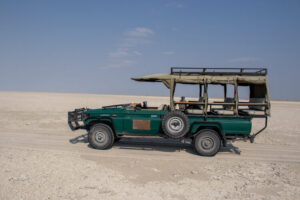
*As Björn describes, these examples of elephant rides and the awefull industry of the canned lion hunts are exactly what we are against here at Ubuntu. The example of visiting meerkats, where only habituation has taken place, is a great way to show that there are other ways to encounter wildlife. Both in Africa and beyond its borders.


0 Comments