

With a total length of 150 centimeters, they are about the size of a child. It makes them the biggest armadillos around and they can be found in Brazil, for example. Gabriel Massocato has spent the past 10 years researching the Giant Armadillo in the dense rainforests of the Pantanal and other Brazilian biomes. Unknown to many, yet extremely important to the survival of the forest and the humans dependent on it.
It is 2010 when the French researcher Arno discovers and publishes the first sighting of a Giant Armadillo in the Pantanal. For Gabriel, who was born in the country and who had been interested in this species for a while now, this was the information that he needed. The Giant Armadillo was the one species that he had never seen before, so he reached out and asked to join his project.
Firstly, he joined as a volunteer. A wonderful year full of experiences and wildlife encounters followed. As the project had just started out, he was part of the first team and the first research attempts on this species. Once the research started, it didn’t take long for them to find proper funding. The Houston Zoo wanted to help by funding another full-time employee, alongside Arno. Driven as he was, the funding went to Gabriel. His conservation career with the Giant Armadillo could continue.
Ever since, the research has been expanding. From monitoring the species to educating stakeholders, schoolchildren, and visitors. All with the aim of showing people that the Giant Armadillo is an important ambassador for biodiversity conservation. If we can save the Giant Armadillo, both humans and nature will thrive along with them.
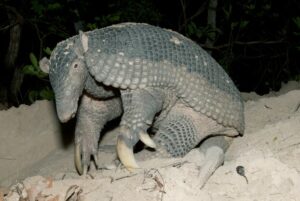
But to create the awareness that they need, research needs to be done. That’s why Gabriel is constantly monitoring the individuals in the area. Since they started in 2011, 36 Giant Armadillos have been captured and tagged with transmitters. It has given them an enormous amount of data to work with. Alongside that, areas have been covered with camera traps, to discover more about their behavior and about their habitat. Now they know that their home range is about 25 square kilometers, that they reach adulthood at about 7 or 8 years old, and that they only give birth to one youngster at a time in their burrows.
That burrow is exactly where biodiversity engineering comes in as a side effect. The burrows, where the armadillo sleeps, rests, and gives birth, are later on used by many other species. Up until now, camera traps have recorded over 70 different species making use of either the burrows or the freshly thrown sand in front of it. That pile of fresh sand is no surprise, by the way, knowing that the armadillo has claws that can grow up to 20 centimeters in length.
This information about the species is the core from which we can protect them. And protection is a necessary thing, knowing that they are constantly threatened by habitat loss through deforestation, wildfire because of the drought, and unethical buying and use of plots of land in the Pantanal. As a result, fragmentation is getting worse and worse. In combination with the fact that the armadillos have a relatively big home range, the future of a Giant Armadillo does not look so bright.
Luckily, Gabriel and his team are working hard on changing that future perspective. The current biggest threat, fragmentation, will be solved with one of their more recent funding. By becoming the Future for Nature award winner of 2022, their newest project of creating corridors between areas of land can be implemented. Cooperating with farmers, eucalypt plantations and citizens can reestablish connected areas of land, through which the Giant Armadillo can forage and move. If it’s up to Gabriel, we need to start celebrating the Giant Armadillo, so that we can protect them and every other species living in their home range.
With funding, the Giant Armadillo project can reach many goals. They have proven that in their prior years. One of the examples comes from the fact that Giant Armadillos have been destroying beehives from local beekeepers. Through a collaboration between Gabriel’s team and the beekeepers, a solution has been found. Nowadays, beehives are hung higher, so that the armadillos can’t reach the beehives anymore. Therefore, there is no more ‘human-wildlife conflict’, but rather a coexistence between both parties. In return, beekeepers doing this get a ‘Giant Armadillo approved honey’-mark, which can be used for higher revenue. It’s one step into a better future for all of them.
Besides funding new projects and addressing different problems, Gabriel’s focus now lies in expanding their research and monitoring work. From the Pantanal – their first research location – they have been expanding to multiple biomes, including the Cerrado. Diversifying to multiple locations will increase their data and their knowledge about the species. In the end, this will definitely help with saving them.
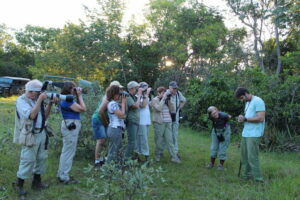
Even though the Pantanal might not be around the corner for you, there are plenty of options for people to visit, or to help, with the Giant Armadillo Project. The team cannot guarantee you a sighting of a Giant Armadillo – as there are so few of them and they are nocturnal as well – but they are more than happy to show you around the area, teach you about their research and perhaps even take you to one of the camera traps to gather some data.
Even if you stay at home, there are multiple options to help. Wherever you are, it helps to share your knowledge about Giant Armadillos. Introduce the people you know to this wonderful species and I am sure they will be amazed. You can even put your own expertise or hobby to use. Imagine being an artist, creating something beautiful about this armadillo to raise awareness. Or use your journalistic background and ability to put stories to words, to spread the message. The options are endless and therefore, anyone can help with conservation.
If you want to know more about Gabriel, his work and the Giant Armadillo, there is so much to be found online. Take a look at the Icas Conservation website or social media channels right here:


0 Comments