
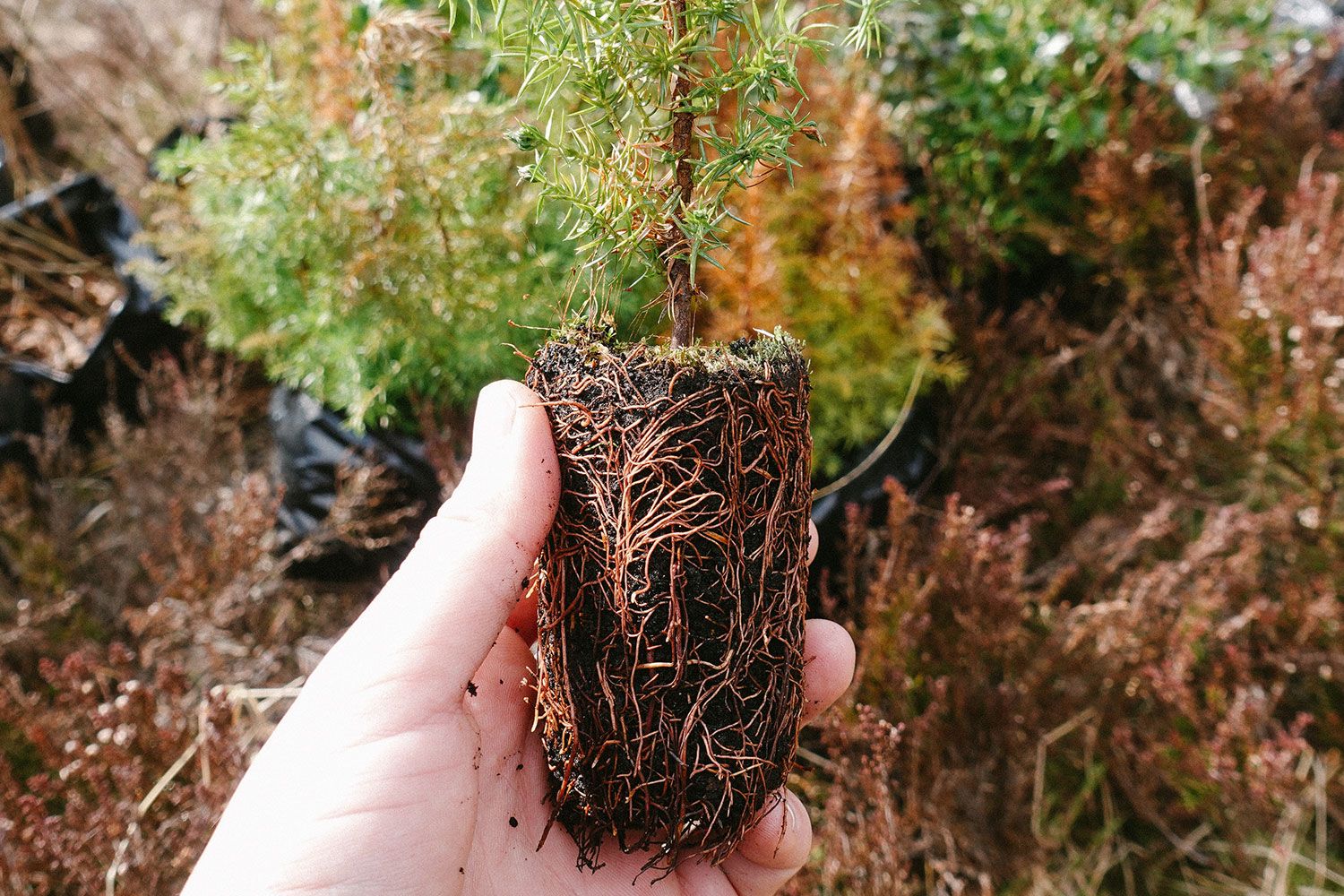
About 50% of Iceland used to be covered in trees. Nowadays, when people visit this island, they will see nearly none. With a current coverage as low as 1.5%, the number of trees has seen a massive decline. Iceland is not unique in that perspective. The number of trees has gone down in many places over the past decades, with unforeseen effects as a result. Matthew Davies and Duarte de Zoeten joined hands to counteract these effects with their organization, Mossy Earth.
Founded in 2017, Mossy Earth works on a greener, wilder, and more biodiverse world through rewilding and reforestation. We talked to Matthew Davies, one of the founders, to find out more about the projects they take on. Nature in general is close to Matthew’s heart, which is also the reason why he traded his job as a teacher to found this organization.
Let’s find out what Mossy Earth has to say.
The story of Mossy Earth
Mossy Earth is an organization that focuses on rewilding and reforestation. We want to help mitigate climate change, improve biodiversity and create a wilder earth. Our membership is a pathway to action, empowering people to fight back and have a real impact by restoring key ecosystems and mitigating their carbon emissions.
Individuals pay ten pounds a month which plants four trees every month and helps contribute to one or more rewilding projects. These can be anything from restoring wetlands to kelp reforestation or reintroducing a species to an area. As soon as you are a member, you can log in to our website or on the app. Here, you will see exclusive content about the projects, such as maps, videos, drone imagery, GPS coordinates, information and more. For us, it is about being as transparent as possible about what we do, but moreover, it is our way of sharing our journey with our members.
Behind the scenes
Besides Duarte and I, the founders, you can find a team of ten people that are working with us. The first team members were biologists. We had limited prior knowledge on rewilding ourselves, so that was something we desperately wanted so that we could make a positive and thought-through impact. The biologists are an important part of our team right now as they set up, implement, and then monitor our research in the field.
With our biologist and the rest of our team, we create projects that we call ‘100% our own’, in which we do everything ourselves. On the other hand, we also have several projects in which we collaborate. Sometimes this means we have funding coming in from another source, but we also have examples in which the expertise of local people or researchers is brought in. Last but not least, we try to gather our tree planters locally so that we don’t have to fly them across the world.
Let’s not forget volunteers, by the way. Some projects lend themselves perfectly for volunteering. When we have such a project, we put out a quest via social media and email communication. One of our latest examples is in Portugal, where we are working on an endemic plant species that lives only here on the sea cliffs. The endemic species is smothered by an invasive species, so it needs to be saved desperately. Every month or two we have volunteers coming in to remove the invasive species from the cliffs.
Planting trees with reforestation
I have been talking about reforestation, but it might be good to dive a little bit deeper into this topic. Planting trees is becoming more and more popular nowadays. That is a great thing as it means people are becoming more aware of protecting the planet. But, tree planting is not as easy as it seems. It can have detrimental effects on the environment if done wrong. One specific example comes from Scotland. Here, some landowners have drained their peatlands to plant trees. However, by draining the peat, carbon will be released. The total amount of carbon that the trees will sequester will not be more than the peat has released, and therefore, this way of planting trees is detrimental to its environment.
Our aim is to restore an area with as many trees as needed and as possible. We plant them in the right place, at the right time, and with the right species. We are extremely careful with that, as it isn’t as straightforward as many people think.
After planting the trees, we would ideally leave the area alone so it can thrive by itself. Some places do need some more human intervention before we reach that stage. In extremely barren areas, we sometimes create waterlines to help these saplings in the first few years. We did that in Portugal, for example, where the saplings had difficulties surviving as they were planted in an area where a forest fire had wiped out all surrounding bushes and trees. In general, we check our tree planting locations for the first three to five years after planting to maximize survival rates.
Selecting rewilding projects
For the rewilding projects that we initiate and run, we are always looking for the highest environmental return of investment for our members. That is one crucial factor when selecting projects. As we are working with nature, we do realize we can never tell for sure, but we try. In addition to that, our biologists are looking for key ecosystem processes, to improve the integrity and to improve the connectivity of our sites. It is really important for us to create areas that are interconnected, to restore biodiversity and the abundance of native species. Another aspect that we are working on is to look for great economic value for the local community. The collective of these objectives are used to find new projects.
Finding common ground
If we dive deeper into rewilding and reforestation, it is interesting to find the common ground. Within all projects that we run – whether it is via rewilding or reforestation – we are looking for benefits for people and nature. One aspect that always comes back is the social impact that we have. With the introduction of the red kite, a bird of prey species in Spain, a foundation for nature-based tourism is being built in the area. As a result, hotels, restaurants, and other companies will benefit from the stream of bird-watching tourists. For us, that is positive as well, as the local people, who are all stakeholders, now get to experience the positive effects of our work in their lives as well. Having them on our side is extremely important for the future of the project and the area.
How to help
Let’s get back to the beginning. Becoming one of our members will always be the best way to support our work. It is a direct way to help plant trees and support our projects. Besides that, it is of great value to us if you talk about our projects and about Mossy Earth. In the past five years we have gathered a modest following, but the more we grow, the more impact we can have.
Living the sustainable life
There are many ways that help the world in becoming greener. Besides rewilding and reforestation, it can also be done at home. With the ‘low impact living guides’ that we created, we help people to minimize their carbon footprint. By implementing these tips, you can take immediate steps into a more sustainable life. We have articles on the subjects of diet, travel, day-to-day living, and more. Just take a look and start implementing the items that you like best.
YouTube: https://www.youtube.com/channel/UC1OLx7nzJgIqwpDzFFrTuLA
Instagram: @mossy.earth
Website: www.mossy.earth


0 Comments