
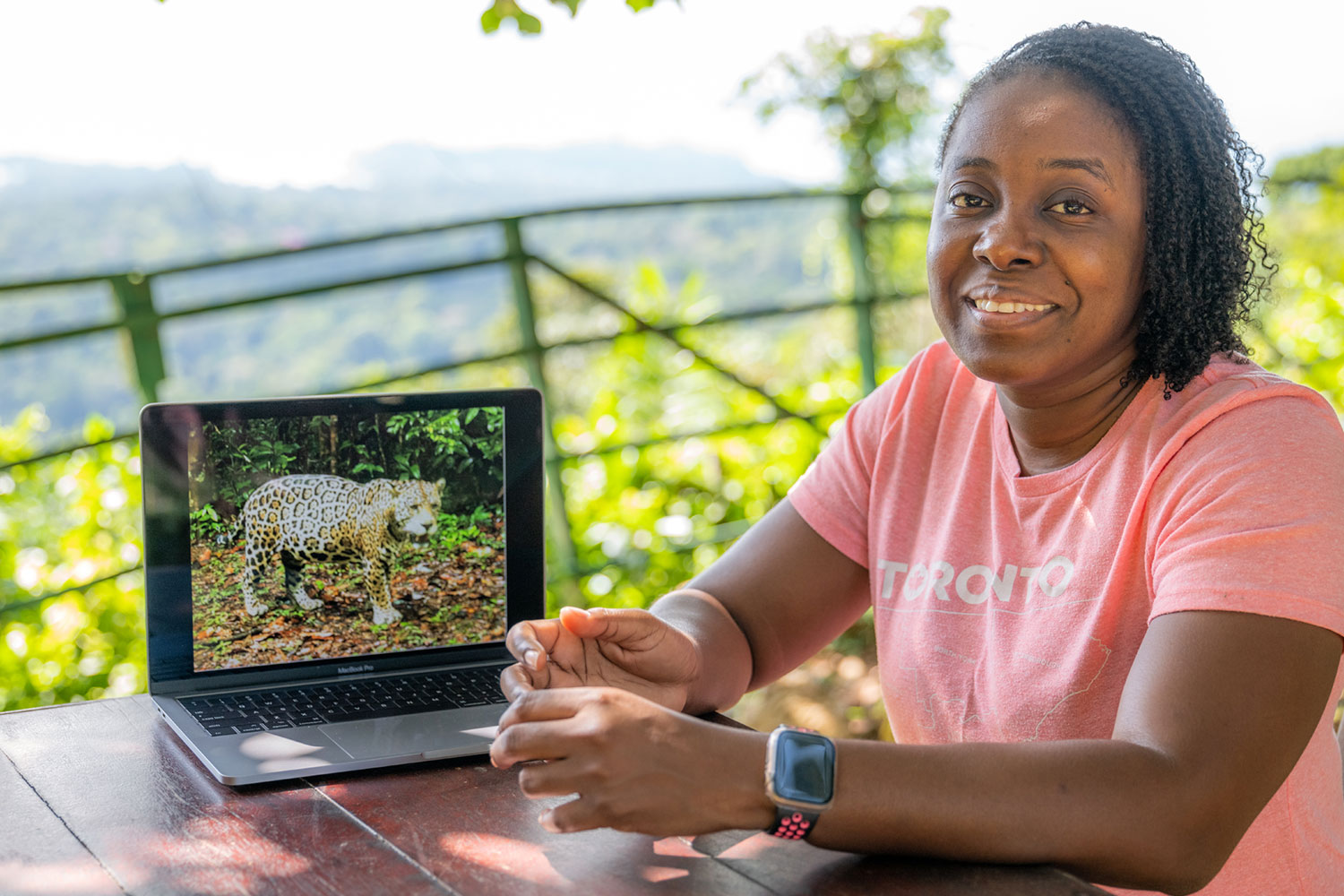
NeoWild (Institute for Neotropical Wildlife and Environmental Studies) is a non-profit organization that aims to improve the conservation of biodiversity and the environment in Suriname. Currently, their main focuses are the threats to jaguars and the impacts of mining and hunting large cats.
In this interview, Vanessa Kadosoe, the founder of NeoWild, shares what it’s like to work in the field of jaguar research and conservation. Vanessa did her master’s and thesis on jaguars, and she’s currently pursuing a PhD about the impact of human disturbance on the jaguar population. We’ve asked her a few questions about Suriname’s jaguar population and what problems these animals face.
First things first, how did you start working in the field of jaguar research and conservation?
My love for nature started because of my mom. She taught us to be gentle with nature, to appreciate it, and to nurture it. My interest in jaguars, however, started during my bachelor thesis research. We put cameras on an ecotourism site to determine the effect of ecotourism on wildlife. When we went through the data, we saw that we captured much data on jaguars, and that’s where my interest started.
What is the core mission of NeoWild?
In a nutshell, the core mission of NeoWild is to do research on and raise awareness about wildlife in Suriname. We’re doing conservation studies on jaguars to determine their population status and in which areas these animals occur the most. The status of the jaguar is not very clear in Suriname and unfortunately, there is a lot of poaching, so we focus on conservation a lot. Although we are specialized in jaguars, we also focus on amphibians, reptiles and water quality.
We know you work in Brownsberg Nature Park. Can you tell us more about this place?
Brownsberg Nature Park is one of the most popular ecotourism sites in Suriname, and it’s very easy to reach. The park was established in 1964 and today, tourism is the biggest source of income in the area. It’s quite wet most of the years and it’s very diverse, with many different species living there. It’s home to an estimated 350 species of birds, for example, so many tourists come here for bird watching.
Jaguars can also be found in this park and they are threatened due to poaching. Can you tell us why these animals are so valuable to poachers?
In the last 5 to 10 years, the poaching of jaguars has increased due to the ban on tiger poaching for tiger paste. People shifted their interest to the jaguar and started making jaguar paste instead. Lately, the jaguar trade has increased, but there’s also more awareness around poaching. People know that it’s illegal, so when someone kills a jaguar, it often gets reported and poachers get a fine. The problem, however, is that they don’t get a big punishment, so it doesn’t really scare them off.
So jaguars get poached to make jaguar paste. What makes this paste so valuable?
In traditional Chinese medicine, jaguar paste is used to enhance sexual potency or to improve health. It hasn’t been scientifically proven that this works, though, but many people believe it does. The poachers earn a lot of money with it too because a small amount of jaguar paste is very expensive. You need to kill one jaguar to produce just a little bit of this paste, and this has an immense impact on the ecosystem. Jaguars keep everything in balance. They’re the top predators of the food chain, and if you pluck out a few of them, the impact on the area is immense.
Can you tell us more about the difference between organized crime and opportunistic crime?
Organized crime is when someone on top of an organization asks a middleman to kill a jaguar. Opportunistic crime, on the other hand, is when someone comes across a jaguar, feels threatened, and decides to kill the animal because they know they can earn a lot of money with it. That person will then sell the jaguar to the people of the organized crime organization. A study has shown that gold miners are also involved in the poaching of jaguars. There’s a lot of poaching going on for the sake of making quick money, but there’s also a lot of organized crime that actively hunts the animals.
What are ways to tackle the trafficking and poaching of jaguars, and which difficulties do you face while doing so?
A couple of years ago, religious and nature conservation organizations joined forces and brought out a statement to the Chinese community to try to stop poaching and illegal trade. It made an impact for a few months, but after that, everything went back to what it was like before.
There have also been people here who tried to infiltrate the Chinese community to gain information, but this is very difficult. You need someone who speaks Chinese, and these people are involved in illegal stuff, so as soon as they find out that you’re involved in conservation, they will stop sharing any information. So, there are a couple of ways to tackle trafficking and poaching, but it is far from easy.
Are there any other threats besides poaching that jaguars face?
Yes! Habitat loss due to gold mining is another problem in Suriname. Entire areas are destroyed for mining activities – forests are cut down, the soil is stirred over, etc. This is largely affecting the entire wildlife population, not only jaguars.
The second threat is excessive hunting. When there is pre-depletion, the jaguar is depleted of food, and they will attempt to hunt closer to villages. Jaguars then attack a chicken or a dog near a village, for example, and villagers may then kill the jaguar.
Do these threats ever scare you, perhaps as a threat to your own safety as you are working with these animals?
Actually, it does. Last week, for example, two of our camera traps were stolen. You can see that poachers are feeling threatened and don’t want evidence of them walking by on camera. When we went out to check on the other cameras, we were fearing for our lives because people put out traps for animals. They attach a thin wire to a stick on one side and to a rifle on the other side. Every time an animal crosses and breaks the wire, the gun will shoot. This is illegal in Suriname but it is being used in certain areas. When we were searching for the cameras, we knew people were hunting there and that there were traps, but we had to go in order to collect the data.
A few times, our cameras have been destroyed too, and another time gas was stolen from the telecommunication tower. We went to the police, but nothing happened. So we’re afraid for our lives, but also for the financial consequences because cameras are expensive. What’s even worse is when data is lost because that’s so valuable to us and our research.
That sounds terrifying, yet you continue to do what you do with NeoWild. What drives you to do the work that you do?
I love the excitement when you retrieve the data from the cameras and see what you have captured. You can spy on jaguars and find out what their life is like: how often they mate or hunt, at what time they are active, etc. I find that very fascinating. Although it’s quite difficult and frustrating sometimes, this kind of information gives you a sense of what the jaguar population is like in Suriname, and that’s very exciting to me.
How can our readers help you and your cause?
We’re a very small NGO, so donations surely help. We have to rely on funding otherwise, but these are very scarce. Doing research is quite expensive, so we need donations to be able to carry out our studies.
Are you curious to read more about NeoWild’s projects, or do you want to make a donation? Then, check them out via the link below.
Website: https://www.neowild.org/


0 Comments